How responsible innovation, qualified language professionals and inclusive service design can work together to remove communication barriers.
Language access is entering a new phase. Artificial intelligence can help organisations handle simple multilingual interactions, digital platforms can connect people faster, and accessible formats can reach audiences who have historically been excluded. Yet the real measure of progress is not the sophistication of the software. It is whether the person receiving a service can understand, participate, ask questions and make an informed decision.

For an NHS clinician speaking with a patient, a social worker discussing safeguarding, or a local authority communicating with residents, the cost of misunderstanding can be far greater than the cost of arranging appropriate support. This is why the future of interpreting and translation is neither exclusively automated nor entirely analogue. It is an intelligently managed combination of technology, professional expertise and accessibility.

Silent Sounds Communications has supported organisations for over two decades and was named Company of the Year at the 2026 Association of Translation Companies Language Industry Awards and 2026 UK Enterprise Awards. That recognition reflects a commitment to innovation grounded in people: using better systems to make expert linguists easier to access, not treating human expertise as obsolete.
What does language access actually mean?
Language access means removing the practical barriers that prevent people from understanding information or communicating effectively. It is broader than translating a document into another language. A person may need a spoken-language interpreter during a consultation, a British Sign Language (BSL) interpreter at an appointment, captions for a recorded briefing, Easy Read information, or a combination of services at different stages of the same journey.
Effective language access starts with an assessment of the individual and the interaction. Is the message routine or clinically sensitive? Is the communication live or written? Does the person use BSL, which has its own grammar and structure, rather than written English? Would a remote interpreter be suitable or does the encounter require someone physically present? These questions should inform the service response before convenience or cost is considered.
In public services, this is also a question of equitable participation. A translated leaflet has limited value if the format is inaccessible to its intended reader. Equally, a rapid automated response is of little use if the recipient cannot verify that critical information has been conveyed accurately.
AI and language services: Where automation helps and where people must lead
AI translation, speech recognition and multilingual virtual assistance have become increasingly capable. In clearly defined, low-risk circumstances, they can help organisations provide directions, opening hours, appointment logistics or an initial understanding of generic content. This can reduce friction and make everyday information easier to find. But fluent output should never be mistaken for guaranteed accuracy, contextual understanding or suitability for consequential decisions.
An automated system may not reliably recognise when an apparently simple exchange contains a clinical concern, an ambiguous phrase, a dialect difference or a disclosure that changes the risk of the conversation. Confidentiality, consent, safeguarding and terminology are not optional extras that can be added after deployment. They must influence whether automation is used at all, what information it processes and when it is escalated to a qualified professional.
InterpretManager: Connecting people with professional interpreters
Technology plays an important role in making professional interpreting services more accessible, responsive and efficient.
Silent Sounds’ InterpretManager platform enables organisations to access qualified human interpreters through streamlined digital workflows, supporting timely communication across healthcare, local government, education and other sectors.
By simplifying access to professional interpreting services, the platform helps organisations overcome practical communication barriers while maintaining the essential role of human expertise, cultural understanding and professional judgement.
For sensitive or complex conversations, including medical consultations, safeguarding discussions and legal matters, appropriately qualified human interpreters remain central to delivering accurate, confidential and effective communication.

Why professional interpreters will remain indispensable
Language is not a sequence of interchangeable words. Meaning depends on context, intent, tone, terminology, cultural conventions and the situation in which an exchange takes place. A professional interpreter is trained to convey meaning accurately and impartially, recognise when clarification is necessary, and maintain professional boundaries under pressure. They do not replace the decision-maker, but they enable that person and the service user to understand one another.
In healthcare this might involve a clinician explaining treatment options while checking a patient’s understanding. In social care it could mean a sensitive family conversation where nuance and neutrality are essential. In a legal consultation, a seemingly small change in wording may materially alter the meaning of an account. These are not circumstances in which organisations should rely on unverified machine output.
The relevant question is not simply whether AI can generate a translation, but whether the organisation can substantiate that the communication was accurate, appropriate and understood. Qualified human interpreters remain essential for precisely those situations where the quality of the exchange matters most. Technology can improve how they are booked, accessed and supported, but it cannot remove the need for their professional judgement.
That is why interpreter qualifications, professional conduct, confidentiality and ongoing development matter. Our guidance on the value of skilled interpreters explains why competence extends well beyond being bilingual.
From digital access to access at the bedside: the InterpretCart example
One of the largest challenges in healthcare is not only finding an interpreter, but making professional interpreting available at the precise moment and place a conversation is taking place. A hospital may have access to a central language-service contract while a clinician on a busy ward still faces delays, device constraints or difficulty connecting to the right professional.
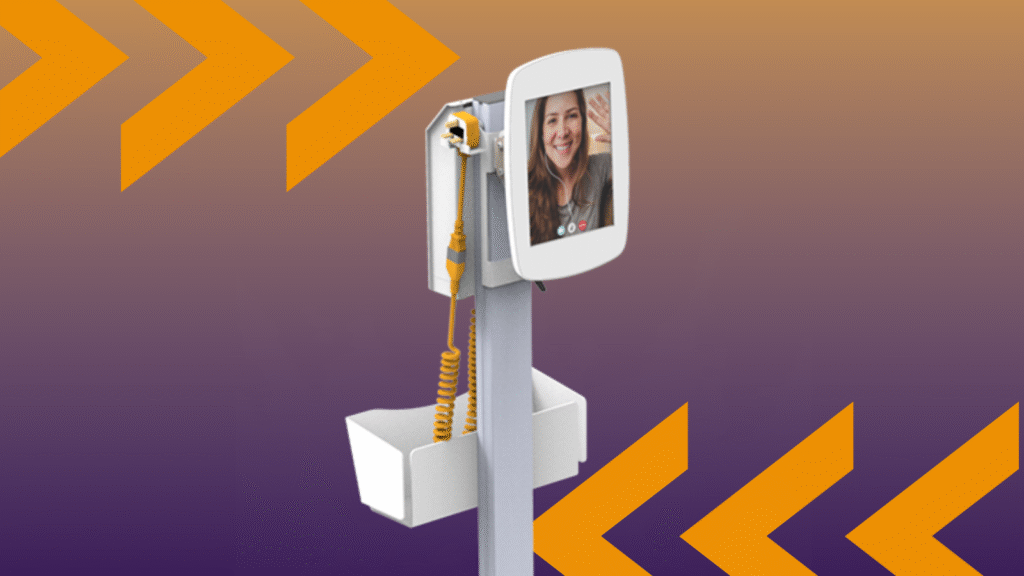
InterpretCart was developed to address this gap. The mobile, height-adjustable interpreting station can be moved between wards and departments, allowing staff to access professional video or audio interpreting in a practical clinical setting. Its easy-clean design and secure, dedicated equipment also help avoid dependence on staff members’ personal devices. The innovation is operational rather than speculative. It brings access to a human interpreter closer to the point of care.
A published Silent Sounds InterpretCart case study describes the deployment of 100 mobile carts across three hospital sites, in an environment serving approximately 40,000 patients each year. The case study reports improved access to language support across departments, including bedside and outpatient use. These are deployment and service-access figures, rather than independently measured improvements in clinical outcomes, but they demonstrate what making language access operationally available can look like at scale.
The InterpretCart service overview provides further detail on its portability, clinical design and multilingual video interpreting capabilities. The lesson for other organisations is that good language access needs more than a supplier contract: Equipment, connectivity, placement, staff awareness and a usable workflow all affect whether the service is actually accessible.
Remote interpreting is a permanent option, not a universal replacement
Video interpreting and telephone interpreting have expanded the choices available to organisations. Telephone interpreting can be effective for brief spoken-language conversations where visual cues are not necessary. Video allows more visual context and is particularly important where BSL is required. Face-to-face interpreting remains appropriate for certain complex, extended or sensitive interactions, or where an individual’s communication needs make remote delivery unsuitable.
Choosing the right method involves more than judging which channel connects fastest. A well-run service considers the urgency and duration of the appointment, language and dialect requirements, accessibility needs, clinical or legal context, and the preferences of the person using the service. A blended model gives service teams the flexibility to respond proportionately rather than imposing one method on every interaction.
BSL access across rural communities: a real-world example
Our BSL video interpreting case study involving a northern NHS Foundation Trust illustrates this approach. The Trust serves communities spread across remote and rural locations, where arranging in-person BSL interpreting could involve significant travel and potential delays. Silent Sounds combined on-demand BSL video interpreting with access to qualified face-to-face interpreters for situations requiring a physical presence.
This enabled the Trust to offer more flexible access without assuming that video is always the best answer. Remote delivery addressed geographical barriers; the face-to-face option preserved choice for more demanding situations. The same decision-making principle applies across spoken-language services, education, community engagement and local government.
Organisations considering a hybrid service can explore our video interpreting service and our explanation of consecutive and simultaneous interpreting, which are different delivery methods and should not be confused with the distinction between remote and in-person appointments.
Translation is a communication outcome, not a word-for-word transaction
The value of professional translation is measured by whether the finished material works for its intended audience. A patient letter may need accurate medical terminology, but it also needs clear structure, appropriate tone and a format that clinical staff can use without extensive reworking. Public information must be understood in context and consistently reproduced across languages. A literal translation that is confusing, inaccessible or unusable can undermine the whole purpose of the communication.
Professional translators also consider how terms and instructions should remain consistent across a suite of documents. Where material is sensitive or regulated, a documented workflow, suitable subject expertise and independent checking are more important than the apparent speed of a first draft. For high-stakes communications, human accountability must be designed into the process.
Case study: Translated materials that are ready to use
A London NHS Trust case study shows how translation can be integrated into a wider operational requirement. Rather than supplying plain translated text alone, Silent Sounds helped the Trust produce professionally formatted patient letters and multilingual posters that retained the original branding and layout. Templates could be prepared before patient-specific details were added, supporting a more practical and privacy-conscious workflow.
The result is an important distinction for commissioners: a translation supplier should understand how information will be distributed, not only what the source text says. When translated material is ready for immediate use, the organisation can reduce additional internal design work and communicate more consistently with the communities it serves.
Accessibility is broader than language
A genuinely accessible service does not assume that everyone receives information in the same way. Some people communicate through BSL; others benefit from captions, speech-to-text reporting, lipreading support, Easy Read, large print, Braille or audio formats. These needs are distinct and should be identified rather than grouped into a generic request for translation.
BSL, for example, is not simply English represented through signs. Providing a written English transcript does not automatically make a service accessible to a Deaf BSL user. Similarly, adding subtitles to a video may help some audiences but does not address every access requirement. Accessibility must be part of the communication design and informed by the person’s needs wherever possible.
For organisations, this means creating a coherent route to support across written, spoken, signed and digital channels. A service might need translated correspondence before an appointment, video BSL interpreting during it, and accessible follow-up information afterwards. Fragmenting these requirements across disconnected processes creates opportunities for people to fall between services.
Silent Sounds provides a range of interpreting, Deaf services, translation and accessible formats so that organisations can plan across the full communication journey rather than treating each interaction as an isolated transaction.
What good language access looks like in NHS and public sector services
Healthcare providers and public authorities face two simultaneous demands: Respond quickly to immediate communication needs and demonstrate that services are consistent, safe and accountable. Reliable access requires more than a round-the-clock telephone number. It relies on clear booking pathways, effective escalation, appropriate interpreter matching, privacy safeguards and management information that helps identify gaps.
When a service specifies a preferred language or dialect, teams should have a straightforward way to capture that need. When an appointment concerns a sensitive clinical, legal or safeguarding matter, the route to a suitably qualified interpreter must be clear. When an interpreter cannot attend, a contingency option should be explored with the service, without assuming that a different mode of interpreting will be acceptable in every case.
Management information is equally important. Looking at fulfilled and unfulfilled bookings, cancellations, connection times, language demand and departmental usage can reveal where an organisation should invest in training, different service channels or additional interpreter recruitment. Procurement teams should also assess quality procedures, qualifications, safeguarding arrangements, confidentiality, and service continuity – not just headline rates.
Silent Sounds’ work across NHS and public-sector services, together with its Crown Commercial Service framework appointment, reflects the importance of combining operational capacity with professional standards. The wider lesson is that a strong language access programme is measured by whether people can use it reliably, not simply whether it exists on paper.
How to build a future-ready language access strategy
A sustainable strategy begins by mapping real communication needs. Organisations should examine the situations in which interpreting or translation is needed, what can safely be handled through routine multilingual support, what always warrants human expertise and where accessibility requirements vary between individuals. The objective is not to automate the greatest possible proportion of interactions. It is to match each interaction to a method that is safe, effective and proportionate.
Next, create practical access routes. Staff should know how to obtain help, what information to provide and how to escalate if an interaction becomes more sensitive than initially expected. Put accessible formats and BSL requirements into service design from the start. Ensure that procurement and governance cover data protection, interpreter competence, confidentiality and a reliable fallback option.
Finally, use evidence to improve the service. Review demand, patient or service-user feedback, and the performance of different channels. If a hospital finds interpreting delays are concentrated on particular wards, portable access may be the answer. If remote communities struggle to access BSL interpreters, a blended video and face-to-face model may be more appropriate. If translated letters are repeatedly reformatted by internal teams, the specification may need to move from text-only translation to complete, usable communications.
The future belongs to technology-enabled, human-led language access
The direction of travel is clear – language services will become more responsive, accessible and integrated into the everyday systems used by organisations. AI has a place where tasks are appropriate and risks controlled. Video, mobile equipment and better workflows can remove delays. But none of these developments alters the underlying need for an accountable, skilled professional when meaning, rights, care or safety are at stake.
Silent Sounds’ experience demonstrates that meaningful innovation is about making professional language services more accessible, reliable and responsive.
Our InterpretCart technology helps bring qualified interpreters directly to the point of care, while InterpretManager simplifies access to professional interpreting services through modern digital platforms.
These are different tools, united by the same principle, and people must remain at the centre of communication.
As an award-winning LSP and ATC Company of the Year 2026 winner , Silent Sounds contunues to invest in innovative solutions without compromising the human expertise, accountability and professional standards that underpin effective communication.
Frequently asked questions
Will AI replace human interpreters?
No. Although AI continues to advance, it cannot replicate the cultural understanding, professional judgement, emotional intelligence and contextual awareness of a qualified human interpreter.
In healthcare, legal proceedings, safeguarding and other sensitive environments, professional human interpreters remain essential. Silent Sounds believes technology should strengthen access to skilled language professionals, rather than replace them.
What is the difference between video and telephone interpreting?
Telephone interpreting is audio-only and can be suitable for many short spoken-language interactions. Video adds visual information and is especially important for signed-language communication. The right option depends on the individual and the nature of the encounter.
Can AI be used for clinical or legal interpreting?
Organisations should not assume that AI output is suitable for high-stakes interactions. Clinical and legal matters demand appropriate accuracy, confidentiality, context and accountability. A qualified human interpreter should be used when these considerations make automated output inappropriate.
How can an NHS Trust improve access to interpreting?
It can combine clear booking processes, appropriately qualified interpreters, remote and face-to-face options, convenient equipment such as mobile interpreting stations, staff training and regular performance monitoring. The best approach is built around the needs of patients and clinical teams.
Why does accessibility include more than translation?
Different people require different formats and communication support. Spoken-language interpreting, BSL, Easy Read, Braille, captions and professional translation address different needs; one format should not be assumed to work for everyone.
Related articles:
The future of interpretation services – on-demand video versus face-to-face
Understanding on-demand interpreting services
Ready to improve language access across your organisation?
Whether you are reviewing NHS interpreting provision, planning accessible public communications or exploring a blended digital and human service, contact Silent Sounds to discuss an approach suited to your organisation. Telephone 01494 796030.