Deaf awareness means understanding the communication needs, experiences and culture of Deaf people and people with hearing loss. But what does it mean to be Deaf aware in everyday life? Being Deaf aware involves recognising communication barriers, respecting individual preferences and making practical adjustments to ensure Deaf people can participate equally.
For businesses, healthcare professionals, schools, local authorities and public-facing organisations, Deaf awareness is an essential part of providing accessible and inclusive services.
However, being Deaf aware involves much more than simply knowing that someone cannot hear. It requires an understanding of Deaf culture, different communication preferences, the role of British Sign Language (BSL) and how everyday decisions can either create or remove communication barriers.
At Silent Sounds Communications, Deaf awareness has been central to our work for more than 25 years. Our company began with a specialist focus on British Sign Language interpreting, and our dedicated Deaf Services team continues to support organisations in making communication more accessible.
What does it mean to be Deaf aware?
Deaf awareness means recognising that Deaf people and people with hearing loss have different experiences, identities and communication requirements.
Some people communicate primarily through British Sign Language, while others use spoken English, lipreading, written communication, hearing aids, cochlear implants or a combination of methods. There is no single approach that works for everyone.
Being Deaf aware means understanding these differences rather than making assumptions about how someone communicates. For example, a healthcare receptionist might assume that writing information on paper is a suitable alternative to speaking. However, for a Deaf person whose first language is BSL, written English may not be their preferred or most accessible form of communication. It is important to recognise that British Sign Language (BSL) is a language in its own right, with its own grammatical structure, syntax and linguistic rules. It is distinct from English, and its meaning cannot simply be transferred word for word into written English. Translating between BSL and English requires an understanding of both languages and their unique structures.
Similarly, speaking more loudly does not necessarily help someone with hearing loss understand what is being said. Effective Deaf awareness starts with a simple principle. Ask the individual how they prefer to communicate, respect their response and provide appropriate communication support.

Understanding the difference between deafness and Deaf culture
An important part of Deaf awareness is understanding the distinction between deafness and Deaf identity. The word deaf is commonly used to describe someone with little or no hearing. It can refer to a broad range of hearing experiences, from mild hearing loss to profound deafness. The capitalised term Deaf is often used by people who identify with the Deaf community, its language, shared experiences and cultural identity.
Deaf culture is an important part of the identity and experiences of many Deaf people. British Sign Language (BSL) is not just a means of communication; it is a language that connects people, supports a sense of community and helps preserve Deaf culture and heritage. Deaf culture includes shared traditions, values, visual communication, storytelling and social connections within the Deaf community. Understanding and respecting Deaf culture helps challenge misconceptions about deafness and recognises the importance of language, identity and belonging. Deaf awareness is about recognising each person’s individual needs and preferences, respecting their language and communication choices, and removing barriers that may prevent them from participating equally. Small changes in awareness and understanding can make a significant difference in creating more inclusive environments.
Deaf awareness is not about treating Deaf people differently. It is about recognising their individuality, respecting their language and ensuring they can participate equally.

Why is Deaf awareness important?
Deaf awareness helps remove barriers that can prevent Deaf people from accessing information, participating in conversations and making informed decisions. These barriers are not limited to difficulties hearing spoken words. They can also arise from inaccessible procedures, inadequate communication support or assumptions made by hearing people. For example, imagine a Deaf patient attending a medical appointment without the BSL interpreter they requested.
The clinician may have excellent medical knowledge, but without appropriate communication support, the patient could struggle to understand a diagnosis, ask questions or make an informed decision about treatment. The problem is not the patient’s deafness. The barrier is the absence of accessible communication. The same principle applies to education, employment, housing, social care and other public services.
Improving Deaf awareness can help organisations:
- Deliver more accessible and inclusive services.
- Reduce misunderstandings and communication difficulties.
- Increase confidence when interacting with Deaf people.
- Support informed decision-making and individual independence.
- Improve the experiences of Deaf employees, customers, patients and service users.
- Recognise when professional BSL interpreting or another communication professional is needed.
Ultimately, Deaf awareness helps organisations move beyond simply recognising accessibility requirements towards actively meeting them.
How to communicate effectively with Deaf people
One of the most practical benefits of Deaf awareness is learning how relatively small changes can make everyday communication more accessible. The following tips can help, although individual communication preferences should always take priority.
Get the person’s attention before speaking
If someone is not looking towards you, they may not realise you are trying to communicate. A gentle wave or another appropriate visual gesture can help attract their attention. Avoid suddenly touching or startling someone unless they have indicated that physical contact is acceptable.
Face the person directly
Facial expressions, lip movements and body language can play an important role in communication. Face the person when speaking and avoid turning away or covering your mouth. Good lighting is equally important, particularly for people who rely on lipreading or visual communication.
Speak clearly without shouting
Speaking more loudly does not automatically make communication easier. Use a natural speaking pace and clear speech. Avoid unnecessarily exaggerating your lip movements, as this can make lipreading more difficult. If someone does not understand, try rephrasing the information rather than simply repeating the same sentence.
Ask about communication preferences
Never assume that every Deaf person uses BSL or that everyone with hearing loss can lipread. Some people may prefer written communication, others may use spoken English, while BSL users may require a professional interpreter. Asking someone what works best is generally the most effective starting point.
Reduce background distractions
Background noise, poor lighting, visual obstructions and people speaking simultaneously can all make communication more difficult. In meetings, encourage one person to speak at a time and ensure that everyone can see the speaker and any interpreter clearly.
Speak directly to the Deaf person
When communicating through a BSL interpreter, address the Deaf person directly rather than speaking to the interpreter. For example, ask “What would you like to discuss?” rather than “Can you ask them what they want to discuss?” The interpreter facilitates communication, but the conversation remains between the participants.
These simple adjustments can make a significant difference to everyday interactions. However, basic Deaf awareness does not replace professional interpreting when complex, sensitive or important information needs to be communicated accurately.
What is the connection between Deaf awareness and British Sign Language?
British Sign Language, commonly known as BSL, is a visual language used by many members of the UK Deaf community. BSL has its own grammar, linguistic structure and vocabulary. It uses hand movements, facial expressions and body language to communicate meaning. It is not simply English expressed through hand gestures.
British Sign Language was formally recognised by the UK Government in 2003 and received further legal recognition through the British Sign Language Act 2022, which recognises BSL as a language of England, Scotland and Wales.
Understanding BSL is an important part of Deaf awareness because it helps organisations appreciate that communication accessibility is not always achieved through written English, captions or lipreading. For someone whose preferred language is BSL, access to a suitably qualified interpreter may be essential for meaningful participation. This is particularly important in situations involving clinical decisions, employment matters, legal proceedings, safeguarding concerns or complex discussions.
Silent Sounds provides professional British Sign Language (BSL) interpreting services across the UK, supporting organisations with face-to-face and video interpreting, alongside specialist advice from our dedicated Deaf Services team.
What is Deaf awareness training?
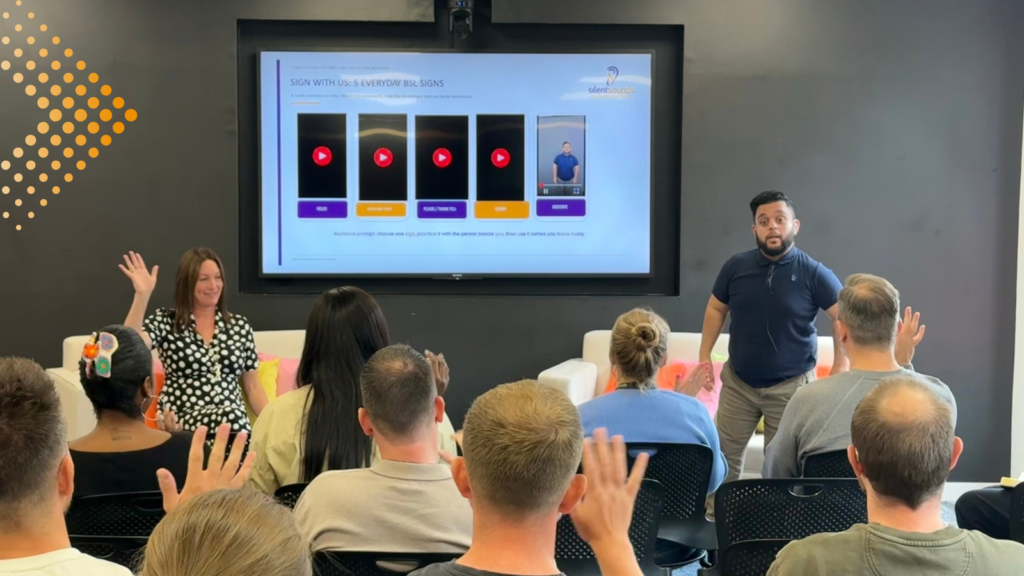
Deaf awareness training helps individuals and organisations develop the knowledge, understanding and practical skills needed to communicate more effectively with Deaf people and people with hearing loss. Rather than focusing exclusively on hearing loss, effective training explores Deaf identity, communication preferences, accessibility and the barriers that Deaf people can encounter in everyday life.
Deaf awareness training with Silent Sounds covers:
- What is British Sign Language (BSL)
- Top tip for communicating with Deaf people
- When should you book an interpreter, and why family members should not be used.
- Incorrect terminology
- BSL alphabet
- BSL greetings
- Questions and responses
- BSL numbers
Deaf awareness training can be particularly valuable for employees who regularly interact with the public, support vulnerable individuals or make decisions affecting access to essential services. Importantly, Deaf awareness training and BSL language training serve different purposes. Deaf awareness training develops understanding and confidence in accessible communication. Learning BSL develops practical language skills. Both can contribute to greater inclusion, but introductory training does not make someone a qualified BSL interpreter.
Deaf awareness in healthcare and the NHS
Accessible communication is especially important in healthcare, where misunderstandings can have serious consequences. Deaf patients must be able to understand information about their health, ask questions, provide informed consent and participate in decisions about their treatment. Healthcare professionals should understand that simply providing written notes or relying on lipreading may not meet an individual’s communication needs. Where a patient requires BSL interpreting, suitable professional support should be arranged.
Deaf awareness can help NHS Trusts, GP practices, dental services and other healthcare providers identify communication requirements earlier and plan appointments appropriately. Staff training can also improve the experience of Deaf patients at reception desks, during triage, in consultations and when arranging follow-up care.
At Silent Sounds, we support healthcare organisations with professional BSL interpreting, including both face-to-face interpreting appointments and remote video interpreting.Our specialist Deaf Services team can also advise on communication arrangements and help organisations understand which type of professional support may be most appropriate.
Deaf awareness in the workplace
A Deaf-aware workplace recognises that employees should have equitable opportunities to contribute, develop and progress in their careers. However, workplace barriers can arise in ways that hearing colleagues may not immediately recognise. For example, meetings held without appropriate interpreting support, telephone-only communication procedures and training videos without accessible alternatives can exclude Deaf employees.
Organisations can improve workplace accessibility by considering communication requirements when planning meetings, recruitment interviews, training sessions and staff consultations. Depending on individual needs, appropriate adjustments may include BSL interpreters, live speech-to-text support, accessible written materials, captioning or alternative communication methods. Managers should also consider the accessibility of informal communication, not just formal meetings. Being Deaf aware means creating an environment where Deaf colleagues are included in everyday conversations, decisions and opportunities.
Deaf awareness in schools and education
Deaf awareness is equally important in schools, colleges and universities. Deaf pupils, students and parents may experience communication barriers during lessons, parent meetings, educational assessments or discussions about additional support needs. Educational institutions should identify individual communication requirements and make appropriate arrangements. This may involve BSL interpreting, communication support workers, specialist educational resources or other accessible communication methods.
For parents who use BSL, providing appropriate interpreting support during meetings can help them participate fully in discussions about their child’s education. For students, inclusive communication supports access to learning, classroom participation and engagement with the wider school community.
Is Deaf awareness a legal requirement in the UK?
There is no universal legal requirement for every employee or organisation to complete a course specifically called Deaf awareness training. However, organisations may have legal duties to provide accessible services and make reasonable adjustments for disabled people.
Under the Equality Act 2010, service providers and employers have responsibilities to avoid unlawful disability discrimination and make reasonable adjustments where applicable. Depending on the circumstances, these adjustments may include providing appropriate communication support, such as professional BSL interpreting.
The British Sign Language Act 2022 provides statutory recognition of BSL as a language of England, Scotland and Wales and establishes certain government reporting and guidance responsibilities.The Act does not itself mean that every organisation must provide a BSL interpreter in every situation. Existing equality obligations, the circumstances and the individual’s communication needs remain important.
Deaf awareness training can support organisations in understanding these responsibilities and adopting more inclusive practices.
How Silent Sounds supports Deaf awareness and accessible communication
At Silent Sounds Communications, Deaf Services are a specialist part of our organisation, not simply an additional interpreting service. Our dedicated Deaf Services department is led by an experienced Level 6 BSL interpreter, and our team includes Deaf colleagues who bring valuable lived experience and understanding of Deaf culture.This specialist knowledge enables us to take a considered approach to each communication requirement.
Rather than simply allocating an interpreter, we can advise organisations on the most appropriate communication professional, whether that involves a registered BSL interpreter, a communication support worker, a Lipspeaker or another specialist. We also offer Deaf awareness and introductory BSL training to help organisations improve staff knowledge, accessibility and confidence.
Our experience spans NHS healthcare, local government, education, housing, legal services and the wider public and private sectors. We understand that effective communication depends on much more than availability. It requires appropriate qualifications, professional standards, cultural understanding and respect for individual preferences.
Building a more Deaf-aware and inclusive society
Deaf awareness is not a one-off exercise or something that should only be considered during Deaf Awareness Week. It is an ongoing commitment to recognising communication barriers, listening to individual needs and creating environments where Deaf people can participate fully.
Small changes in everyday behaviour can make communication more welcoming and accessible. However, meaningful inclusion also requires organisations to review their procedures, provide appropriate training and ensure that professional communication support is available when needed. Understanding Deaf culture, respecting British Sign Language and involving Deaf people in decisions about accessibility are important steps towards achieving this.
Deaf awareness begins with understanding. Genuine inclusion comes from putting that understanding into practice.
Improve Deaf awareness within your organisation
Whether you are looking to improve staff confidence, arrange Deaf awareness training or provide accessible communication for Deaf service users, Silent Sounds can help.Our specialist team supports organisations across the UK with Deaf awareness, professional BSL interpreting and a comprehensive range of Deaf communication services.
Explore our British Sign Language interpreting services or contact Silent Sounds to discuss how we can support your organisation.
Related articles:
Celebrating Deaf awareness, cultural awareness and the power of inclusion
Silent Sounds at Hughenden Gardens’ Deaf Awareness Day